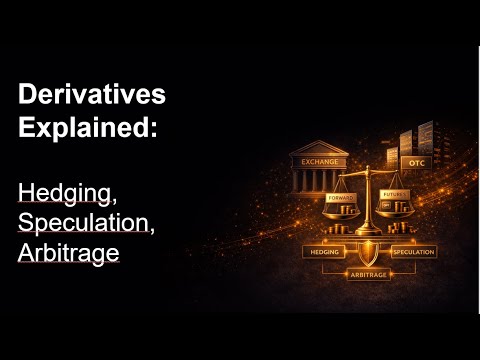
Derivatives: the eight key steps of the series, from futures to Black-Scholes
Educational and informational content only. It does not constitute investment advice, a recommendation or a solicitation. Derivatives are complex instruments and can lead to losses exceeding the capital invested. Numerical examples are hypothetical.
The derivatives video series now runs to a dozen episodes, and there is no need to summarise them all. These are the eight steps that hold up the rest: the ones worth having clear before looking at a pricing model or reading a structured product's prospectus. Each step points to the episode that covers it in full, with video and companion note, on the series page.
1. Futures work without trust
A private forward contract holds as long as the counterparty stays solvent. Futures start from the opposite assumption: trust is not needed. A clearing house stands between buyer and seller, and every evening the position is revalued at the settlement price. Losers pay, winners collect. If the account falls below the maintenance margin, a margin call follows.
The consequence is a curious one. The system as a whole becomes safer, because no loss can build up for months without being paid; the individual trader is more exposed, because with a 10% margin a 3% drop in the underlying wipes out 30% of what was posted. → Episode 2
2. Hedging reduces risk; it does not remove it
Hedging an exposure with futures swaps price risk for a smaller, different risk, basis risk: the gap between spot and futures prices on the day the hedge is closed. The number of contracts that minimises the variance of the hedged position depends on correlation and volatility:
With a correlation of 0.9 and volatilities of 2% and 2.5%, the optimal ratio is 0.72, not 1. For an equity portfolio the same role is played by beta against the index. In both cases the estimates come from the past and can let you down exactly when the hedge matters most. → Episode 3
3. A forward price is a calculation, not a forecast
Buying the underlying today and holding it to expiry must cost the same as buying it forward. If it didn't, someone would buy where it is cheap and sell where it is dear until the gap closed. Hence the cost-of-carry formula:
where is the dividend yield for an index, the foreign interest rate for a currency, or the convenience yield net of storage costs for a commodity. With the index at 100, rates at 4% and dividends at 2%, the one-year price is about 102.02. A future above spot does not mean the market expects a rise: it means money costs more than the dividends pay. The same logic gives forward interest rates, which are implied by today's zero curve rather than predicted. → Episode 4 · Episode 5
4. Interest-rate risk is measured in money per basis point
For a bond portfolio the useful question is concrete: how much is lost if yields rise by one basis point? That is DV01.
Ten million with a modified duration of 6 gives €6,000 per basis point; if a bond future has a DV01 of €90, the hedge needs about 67 contracts. It works for small parallel shifts of the curve, and only for those. An interest rate swap works on the same lever: paying fixed and receiving floating is, in effect, being long a floating-rate bond and short a fixed-rate one, and the swap is worth the difference between the two. → Episode 6 · Episode 7
5. An option is an asymmetry, and asymmetry has a price
A future gains and loses in a straight line. A long option does not: above the strike the call follows the underlying, below it the loss stops at the premium paid.
That bent shape costs money. The premium holds intrinsic value plus a time value that pays for the chance of favourable moves before expiry, and that erodes day after day. On the other side, the option writer collects the premium and takes on the risk the buyer has offloaded. Multi-leg strategies (covered calls, protective puts, spreads, straddles) do not create value from nothing: they move gains and losses from one part of the chart to another, and those that look almost safe usually hide a rare but large loss. → Episode 8 · Episode 10
6. Calls and puts are tied by a constraint
Before any model there is a relationship that leaves no room for opinion. A call plus a deposit equal to the discounted strike pays exactly the same at expiry as a put plus the underlying, so today they must cost the same:
With underlying and strike at 100, rates at 3% and one year to expiry, if the call is worth 10 the put must be worth 7.04. If prices across an option chain break parity, net of costs and dividends, something somewhere is wrong. → Episode 9
7. Pricing by replication
The most important conceptual step in the series is also the easiest to see on a binomial tree. If an underlying at 100 can rise to 110 or fall to 90, half a share minus one call with strike 100 is worth 45 either way. A riskless portfolio must earn the risk-free rate; at 5% it is worth 42.81 today, so the call is worth 50 minus 42.81, that is 7.19.
The probability that the price goes up never enters the calculation. Only what can be bought and sold today does. The same idea underpins far more complex models, and it explains why an option's price does not depend on the buyer's optimism. The number of shares that makes the portfolio riskless, 0.5 here, is the delta. → Episode 11
8. Black-Scholes and implied volatility
When the tree's steps become infinitesimal, the underlying follows geometric Brownian motion: uncertainty grows with the square root of time and the log of the price is normally distributed. A 20% annual volatility becomes roughly 5.8% over a month. Itô's lemma then leads to the Black-Scholes formula:
Of its five inputs, four can be observed in the market; volatility cannot. That is why the market uses the formula backwards: it starts from the price and backs out implied volatility. With underlying and strike at 100, rates at 3% and 20% volatility, the call is worth about 9.41; if it trades at 10.50, the market is pricing a volatility close to 22.8%. The fact that implied volatility changes from one strike to the next, the smile, is the most visible sign of the model's limits: jumps, fat tails, volatility that does not stand still. → Episode 12
The common thread
The eight steps tell the same story from different angles. A derivative's price does not depend on what we think will happen, but on what can be replicated today with instruments that already trade, and arbitrage is the mechanism that keeps prices together. Understanding this does not make derivatives less risky. It does help you recognise when a product promises something the numbers cannot deliver.
The full episodes, each with its own note, are in the Derivatives series. For the basics: Derivatives: what they are and how they work.
Sources
J. C. Hull, Options, Futures and Other Derivatives, 10th ed., ch. 2-7 and 10-15 · Borsa Italiana, derivatives glossary.
This information is for educational purposes only. It is not a recommendation or personalised advice. Past performance is not a guarantee of future results.